
Betting faces the financial gap
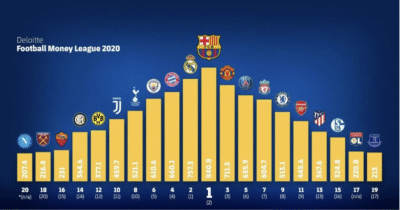
Deloitte Football Money League 2026 proves the growing gap between the biggest clubs and other European football organizations. Top 20 clubs in the ranking have crossed the €12 billion mark in revenue for the first time in the 2024/25 season, accumulating €12.4 billion. In such a football economy, 1xBet sports bets also follows the financial gaps between squads as well as revenue and bench strength.
A summit that keeps rising
Real Madrid tops the Money League with revenue of nearly €1.2 billion and becomes the first football club to overcome that mark in the Deloitte report. The club leaves FC Barcelona, which stands second with revenue of €975 million, followed by Bayern Munich (€861 million), Paris Saint-Germain (€837 million) and Liverpool (€836 million). Thus, the gap between first and fifth exceeds €300 million.
This statistic changes the sporting approach. A club that makes €1.16 billion can easily cope with the lack of major titles, invest in infrastructure, hold expensive players, and attract sponsors. A club whose revenue is about €400 million or €500 million needs to make tougher decisions.
The top 20 are not moving together
The overall progress is impressive, but does not reveal the full picture. Top 20 clubs generate revenue of €12.4 billion, up 11% from the previous season. Such growth is achieved thanks to commercial revenue, broadcasting rights, and matchday income. According to Deloitte, the latter reaches €5.3 billion in top 20 clubs, becoming the first major revenue source to exceed €5 billion.
| Rank | Club | 2024/25 revenue |
| 1 | Real Madrid | €1.161 billion |
| 2 | FC Barcelona | €974.8 million |
| 3 | Bayern Munich | €860.6 million |
| 4 | Paris Saint-Germain | €837 million |
| 5 | Liverpool | €836.1 million |
| 6 | Manchester City | €829.3 million |
The details show an increasing concentration. Teams that can market their brand in different regions, fill their stadiums, and monetize premium zones get an advantage that becomes increasingly difficult to overcome.
Betting also reads squad depth
Revenue does not score goals, but it changes probabilities regarding the upcoming season. A wealthier team can strengthen two positions without selling its key player. It can provide high salaries, recruit players early and cope with a prolonged injury due to a stronger bench.
This aspect also impacts football betting. Users interested in football betting 1xBet focus on the current form of teams, but the financial aspect is always in the background. Squad depth, European participation, rotation opportunities, and managerial stability play a role in predicting the outcome of a season. A wealthier club is not guaranteed to win, but it almost never begins a season under the same constraints as a less-equipped opponent.
Such financial context may help users to make informed comparisons between teams, but betting should still be limited to personal capacities. Prices, odds, and squad depth provide valuable signals, but are not guarantees.
Stadium revenue changes the hierarchy
The stadium is becoming a key factor. Deloitte highlights that top 20 clubs generate matchday revenue of €2.4 billion in the 2024/25 season. This flow of money is not provided by ordinary tickets anymore. It is supplemented by hospitality services, boxes, tours, events, and premium offers.
This trend benefits clubs that own their stadiums and effectively exploit them. Real Madrid gains from the new stadium. Tottenham remains high in the ranking due to a very efficient stadium-based business model. Arsenal, Liverpool, and Barcelona benefit from their capacity to generate matchday revenues in a variety of ways.
The most obvious sources of the difference include:
- higher global commercial revenue;
- efficient stadium usage throughout the year;
- higher European competition bonuses;
- greater brand value;
- squads capable of producing additional sporting and marketing revenue.
Costs are also rising
Despite impressive revenue growth, not all clubs become more profitable. UEFA states that revenue from European club football is expected to exceed €30 billion in 2025 after €28.6 billion in 2024, but costs are growing dramatically. Operating expenses, non-player wages, and financing costs reduce the impact of record revenue.
The logic is rather straightforward: the more a club earns, the more investments it needs to make to remain in the same league. Salaries, transfers, academies, women’s teams, workforce, sport data and commercial activity require bigger budgets. Record revenue does not protect from losses when costs grow faster.
A ranking that points to what comes next
Deloitte Football Money League 2026 not only reveals who makes the most money. It demonstrates how European football is becoming divided. Wealthy clubs are creating an advantage based on commercial revenue, stadiums, European competitions, and worldwide recognition. Other clubs need to develop their marketing capabilities, recruit more efficiently and avoid costly mistakes.
For fans, this split can make certain seasons predictable. For football betting, it creates one more layer of analysis apart from football itself. For clubs, it means tough reality: staying competitive does not depend on a successful coach or talented generation anymore. It depends on economic potential capable of coping with the richest clubs.